
Engineering Dyne Control for PVC Core Sheets in Offset Card Printing
A practical guide from HongFilms (calendered matte PVC Card Core Sheet)
Offset card printers often ask one question first: “What dyne level do we need for PVC core sheet?”
Dyne level (wetting tension) is a fast indicator for wetting, but it is not a guarantee of long-term ink adhesion.
This guide explains how to set dyne targets as a window, how to test them consistently, how to manage dyne decay during storage, and how to validate adhesion using recognized methods and standards.
Key takeaways
- In general, a material wets well when the substrate surface energy is higher than the liquid’s surface tension; if not, wetting and adhesion issues are likely. [2][4]
- Dyne level is a screening tool for wetting and surface treatment consistency, not a standalone guarantee of adhesion. Always validate with an adhesion test on your actual press conditions. [1][7][8]
- Offset (litho) dyne targets vary by ink chemistry (water-based, solvent-based, UV-curable). Use a target window, not a single number. [1]
- Dyne increase from corona treatment is not permanent; factors such as time, handling contamination, environment (humidity/storage), and additive migration can reduce dyne level during storage. Re-check dyne at print time. [3][5]
- One dyne reading cannot represent an entire roll. A meaningful QC approach includes test method alignment, side identification, and mapping across width/length. [5]
1) What dyne level tells you (and what it doesn’t)
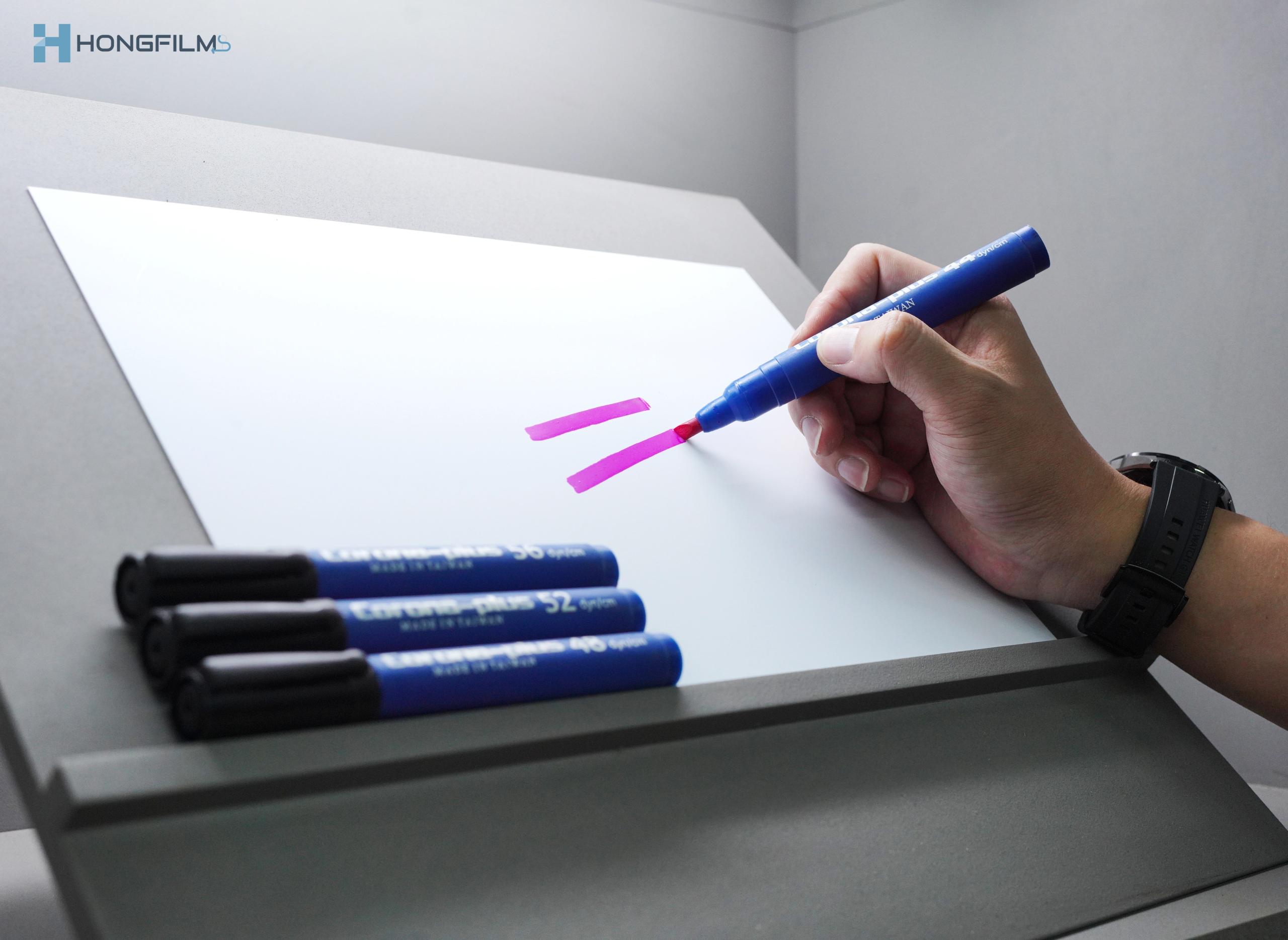
Dyne level is commonly used to express wetting tension (often written as dynes/cm; numerically equivalent to mN/m). ISO 8296 specifies a method for determining wetting tension of plastic film and sheeting using drops of defined test solutions. [6]
Dyne level is useful for answering:
Will the ink/solution wet out or bead up on the surface?
Dyne level does not automatically guarantee:
Durable adhesion after drying/curing, scuffing, handling, lamination, ageing, or environmental exposure.
That’s why practical acceptance should include an adhesion test such as ISO 2409 (cross-cut) and/or ASTM D3359 (tape test), conducted under your real printing conditions. [7][8]
2) HongFilms baseline and when corona treatment makes sense
HongFilms produces calendered PVC Card Core Sheets with a matte surface (sandblasted roller finish). Our typical outgoing wetting tension (untreated) measures ≥36 dyne/cm on one side and ≥38 dyne/cm on the other.
How to interpret this baseline:
Untreated matte PVC can be workable for some offset setups when ink chemistry and press conditions are well matched.
Many printers—especially for duplex printing, water-based systems, UV-curable systems, demanding press speeds, or longer storage cycles—prefer corona-treated surfaces to increase wetting reliability. [1][3]
For duplex jobs, treat and verify both sides independently to avoid “Side A OK, Side B fails.”
3) Setting dyne targets for offset printing (use windows by ink chemistry)
A practical specification should answer three questions:
What is the target dyne window?
How is it measured?
When is it verified (at shipment and/or at print time)?
Industry guideline windows (Offset/Litho on PVC)
Enercon publishes general recommended surface energy/treatment ranges by process and ink chemistry. For Offset/Letterpress printing on PVC, their guideline ranges are: [1]
| Ink chemistry | Guideline wetting tension (dyne/cm) |
| Water-based | 40-45 |
| Solvent-based | 38-42 |
| UV-curable | 40-52 |
These are starting points for evaluation, not a contractual guarantee. Final targets should be validated with your ink system, press conditions, and adhesion testing. [1][8]
A recommended way to write dyne requirements (to avoid disputes)
Wetting tension (dyne/cm): target window agreed for the ink system (water/solvent/UV).
Test method: ISO 8296 (or an equivalent agreed method). [6]
Sampling: both sides, mapped across width (edge/center/edge) and along length (start/mid/end).
Timing: checked at shipment and re-checked before printing, especially after storage. [3][5]
4) Dyne testing practice that improves repeatability
If supplier and customer measurements disagree, it is usually a method alignment issue. To improve repeatability:
Use the same test method and the same dyne solutions/pens, and agree on the wet-out pass/fail rule. [6][5]
Avoid touching the test zone; oils and dust contamination can reduce wetting and create false negatives. [3][5]
Map across the roll rather than testing a single point; treatment uniformity and handling can vary across width and along length. [5]
5) Managing dyne decay: storage, timing-to-print, and re-check policy
A film’s dyne level increase due to corona treatment is not permanent. Printing.org summarizes common drivers of dyne decay as additive migration, handling contamination, environment (humidity/storage), and natural time decay. [3]
Practical policy (recommended):
If material is stored/shipped before printing, measure dyne again at print time. [3]
For demanding runs, consider installing corona treatment on the converting/printing line for a light, last-minute pass to refresh surface energy.
Enercon describes this approach as “bump treating”: placing corona treater(s) immediately before applying inks/coatings/laminations to create a fresh treated surface and widen the operating window. [5]

6) Troubleshooting flow (If/Then)
Case A: Dyne meets target, but adhesion fails
If dyne is in range but adhesion fails, treat dyne as “wetting likely OK” and shift to ink compatibility, curing/drying conditions, contamination, and process variables. Validate with ISO 2409 / ASTM D3359. [7][8]
Case B: Supplier dyne ≠ customer dyne
If measurements disagree, align on the test method, solution set, pass/fail criteria, sampling map, and the timing of measurement (fresh vs stored). [6]
Case C: One side prints well, the other side scuffs/peels
If duplex printing shows side-to-side inconsistency, test and (if needed) treat both sides separately and map across roll width/length. [5]
Case D: Old stock fails, fresh stock passes
If older stock prints worse than fresh stock, suspect dyne decay drivers (time, humidity/storage environment, additive migration, contamination). Re-check dyne before printing and consider fresh treatment close to processing. [3][5]
7) How to validate adhesion (recommended acceptance tests)
ISO 2409 — Cross-cut test
ISO 2409 specifies an empirical method for assessing resistance to separation when a lattice pattern is cut into a coating down to the substrate; it is not a direct measurement of adhesion strength. [7]
ASTM D3359 — Tape test (Method A / Method B)
ASTM D3359 is widely used to rate adhesion of coating films, including on non-metallic substrates such as plastics (method selection and interpretation should be agreed). [8] For practical understanding of the two methods (X-cut vs lattice), an accredited lab summary is helpful. [9]
References
[1] Enercon — Recommended Surface Energy & Treatment Ranges for Printing & Coating Polymer Surfaces
[2] Vetaphone — Wetting rule (surface energy vs liquid surface tension)
[3] Printing.org — Dyne decay drivers: additives, contamination, environment (humidity/storage), time
[4] Avery Dennison — Surface tension and corona treatment (wetting/adhesion explanation)
[5] Enercon — “Bump treating” definition and process benefits
[6] ISO 8296 — Plastics film and sheeting — Determination of wetting tension
[7] ISO 2409 — Paints and varnishes — Cross-cut test
[8] ASTM D3359 — Standard Test Methods for Rating Adhesion by Tape Test
[9] Micom Laboratories — Practical summary of ASTM D3359 Method A/B
About HongFilms
HongFilms manufactures calendered PVC Card Core Sheets for card production (bank cards, hotel key cards, gift and loyalty cards), including matte finishes suitable for printing, and optional surface treatment solutions based on customer printing processes.
Prepared by: HongFilms Technical Team
Company: JinJiang HongFilms
Location: Jinjiang, Fujian, China
Contact: [email protected]
Disclaimer: Information is provided as general guidance; results depend on ink chemistry and process conditions.