
This section provides a comprehensive exploration of MD direction stretching shrink film, particularly its application in dry battery labels, drawing from extensive research and industry insights. The analysis aims to offer a professional and systematic overview.
Background on Shrink Film and Its Packaging Role
Shrink film, a polymer plastic film, is designed to shrink tightly over objects when heated, making it a staple in packaging for protection and presentation. Its versatility spans industries, including food, beverages, electronics, and pharmaceuticals, with specific applications in labeling cylindrical objects like dry batteries. The film’s ability to conform to shapes ensures it provides both functional and aesthetic benefits, such as tamper evidence and enhanced brand visibility.
Research highlights its use in various packaging scenarios, with common applications including bundling multipacks and protecting delicate components. For dry batteries, shrink film serves as a label that not only identifies the product but also protects it from environmental factors like moisture and dust. This dual role is critical in maintaining battery performance and safety during storage and transportation.
Understanding MD Direction Stretching
MD direction stretching refers to the process where the shrink film is stretched along the machine direction during production, which is the direction the film moves through the production line. This stretching aligns the polymer chains, creating a “memory” effect where, upon heating, the film shrinks back toward its original dimensions. This orientation is achieved through processes like tenterframe or bubble methods, where the film is heated and stretched, then cooled to set its properties.
The significance of MD stretching lies in its impact on the film’s shrinkage behavior. When the film is MD stretched, it will predominantly shrink in the machine direction when heated, which is crucial for applications requiring directional shrinkage. This is particularly relevant for cylindrical objects, where the film’s shrinkage needs to align with the object’s geometry for a tight fit.
Specific Application in Dry Battery Labels
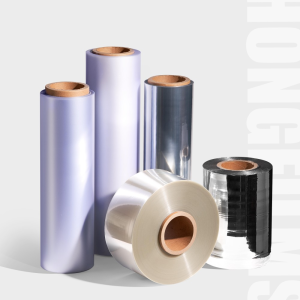
In the context of dry battery labels, MD stretched shrink film is employed to create labels that wrap around the cylindrical battery. The film is typically produced in a roll, with the machine direction being the length of the roll. When cut and wrapped around the battery, the MD of the film corresponds to the circumferential direction of the battery. Upon heating, the film shrinks in this direction, ensuring a snug, wrinkle-free fit that enhances both protection and aesthetics.
The application process involves several steps:
- Label Preparation: The shrink film is printed with necessary information, such as brand logos, safety warnings, and technical specifications, often using methods like rotogravure or flexography.
- Wrapping: The printed film is wrapped around the battery, aligning the MD with the circumference.
- Sealing: The edges are sealed to form a continuous sleeve, ensuring no gaps.
- Shrinking: Heat is applied, typically through a heat tunnel or gun, causing the film to shrink and conform to the battery’s shape.
This process ensures the label not only fits tightly but also provides a durable barrier against environmental factors, enhancing the battery’s shelf life and safety.
Material Selection and Properties
The choice of material for MD stretched shrink film in dry battery labels is critical and includes:
- PVC (Polyvinyl Chloride): Known for its clarity and printability, PVC is cost-effective and widely used, though its environmental impact is a concern due to harmful byproducts during decomposition.
- PET (Polyethylene Terephthalate): Offers high strength and stability, suitable for applications requiring durability, with excellent shrinkage properties.
- Polyolefin: FDA-approved for food contact, it provides durability and is increasingly preferred for its recyclability, aligning with sustainability goals.
Each material’s properties, such as tensile strength, shrinkage rate, and chemical resistance, are tailored to meet the specific needs of battery labeling. For instance, polyolefin’s resistance to moisture and chemicals makes it ideal for household batteries, while PET’s high shrink rate ensures a tight fit on various battery sizes.
Advantages of MD Stretched Shrink Film
The use of MD stretched shrink film in dry battery labels offers several advantages:
- Tight Fit: Ensures the label adheres closely to the battery, preventing loosening during handling or transportation.
- Durability: Provides a protective layer that shields the battery from dust, moisture, and physical damage, extending its usability.
- Aesthetic Appeal: Allows for full-color, 360-degree labeling, enhancing brand visibility and consumer appeal on store shelves.
- Cost-Effectiveness: Integrates protection and labeling in a single step, reducing material and labor costs compared to separate processes.
An unexpected detail is the impact of material choice on recyclability, with polyolefin films like those from Taghleef Industries being certified recyclable, supporting environmental sustainability (Shrink Sleeve Label Films | Taghleef Industries).
Challenges and Considerations
Despite its benefits, there are challenges in using MD stretched shrink film for dry battery labels:
- Shrinkage Control: Precise control over the shrink percentage is essential to avoid over-shrinking, which could distort the label, or under-shrinking, leading to a loose fit. This requires advanced equipment and process monitoring.
- Print Registration: The label design must account for the shrinkage in the MD, ensuring that printed graphics and text remain aligned and legible post-shrinkage. This often involves pre-distorting the design to compensate for the shrinkage.
- Material Compatibility: The film must be compatible with the battery’s materials to avoid chemical reactions that could affect performance or safety, particularly important for lithium-based batteries.
These challenges necessitate careful selection of materials and optimization of the manufacturing process to ensure consistent quality and performance.
Comparative Analysis: MD vs. TDO Stretching
While MD stretching is critical for circumferential shrinkage in battery labels, it’s worth noting the comparison with TDO (Transverse Direction Orientation). TDO films, stretched in the width direction, are often used for shrink sleeve labels in other applications, such as bottles, where height shrinkage is beneficial. However, for cylindrical battery labels, MD stretching is preferred for its ability to ensure a tight circumferential fit, aligning with the geometry of the battery.
Conclusion
MD direction stretching shrink film is a vital technology in the packaging of dry batteries, offering a combination of protection, functionality, and aesthetics. Its application ensures a tight, durable label that enhances product safety and brand visibility. As the industry evolves, addressing challenges like shrinkage control and embracing sustainable materials will be key to maintaining its relevance and effectiveness in modern packaging solutions.
Table: Comparison of Materials for MD Stretched Shrink Film

This table summarizes the key properties, aiding in material selection for battery label applications.